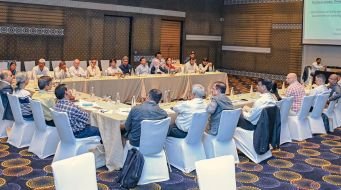
WOTR & W-CReS, with the support of GIZ, brought together multiple stakeholders, researchers, policymakers, and development practitioners to explore a fundamental question: How do we build resilient food systems in an era of climate uncertainty?
At this year’s IUCN World Conservation Congress in Abu Dhabi, a new global report was released that carries an important message for our planet: to restore the land, we must first reconnect it.
WOTR and W-CReS, in collaboration with the Economics of Land Degradation (ELD) Initiative, GIZ, organised a national roundtable titled “Restore Land through Integrated Efforts – Unlocking Opportunities for Today’s Needs and Sustainability Tomorrow.”
FarmPrecise app has crossed 1 lakh downloads, equipping farmers across four Indian states with hyper-local, real-time insights and AI-powered recommendations.
Every year on October 12, we commemorate the birth anniversary of Father Hermann Bacher and celebrate it as Shramdan Diwas. This year marks 101 years of his birth and legacy.
Partnership to integrate ecosystem services, biodiversity conservation, and community participation into climate-resilient policies, addressing Maharashtra’s water scarcity and agricultural vulnerability.
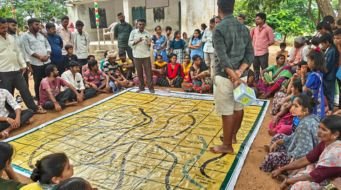
It’s unusual that science, soil, and stories come together in a single space but something quietly transformative happened during W-CReS’s recent CDVI workshop in Odisha
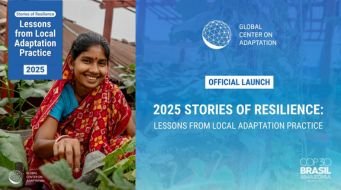
Drawing from work with smallholder farmers—from Kumbharwadi in Maharashtra to Madaul in Odisha—WOTR has contributed key experiences, insights, and evidence to the Stories of Resilience 2025, a publication launched by the Global Centre on Adaptation (GCA) at the United Nations Climate Change Conference in Belém, Brazil.
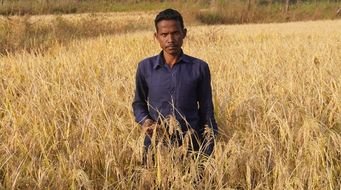
Phool’s journey from uncertain, monocropping to stable, climate-resilient agriculture shows how access to irrigation, diversification, and community support can transform livelihoods.
Grasslands are often mistaken for empty lands needing trees, but they are rich, climate-resilient ecosystems. Understanding their unique biodiversity, carbon storage, and cultural value is essential to ensuring conservation efforts don’t unintentionally cause harm.
Recently, multiple large-scale awareness campaigns were conducted in 15 villages across diverse regions of Rangareddy and Jalna districts in Telangana and Maharashtra, respectively, where the Water Stewardship Initiative (WSI) is being implemented.