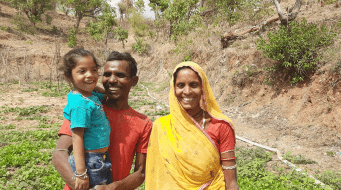
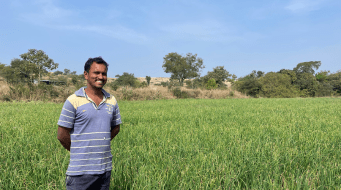
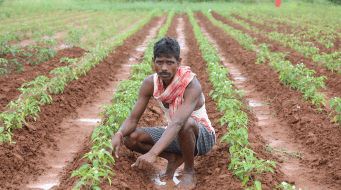
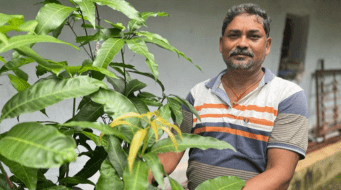
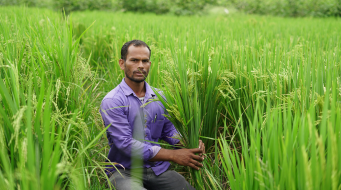
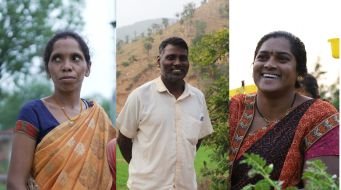
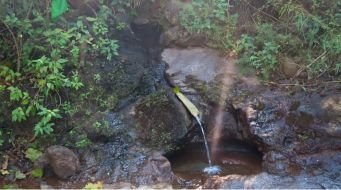
Furkhan and Shahinbee Patel struggled with farming due to severe water scarcity on their 11-acre farm in Hokrana village of Karnataka. In 2022-23, a restoration project by Wells Fargo and WOTR created a water harvesting potential of 22 million liters, significantly improving their irrigation and doubling their harvests.
A Better Tomorrow
Stories, Practices, and Solutions
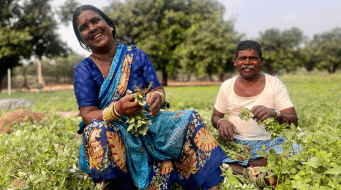
Polamoney Buchaya, 63, and his wife Bugamma, 54, transitioned to farming after Buchaya’s heart attack in 2020, cultivating green leafy vegetables on leased land. Supported by WOTR and HSBC, they adopted rainpipe irrigation, enhancing water efficiency and crop yield. This shift increased their earnings significantly, providing a steady income. Their success has inspired other farmers in their village to adopt similar practices.
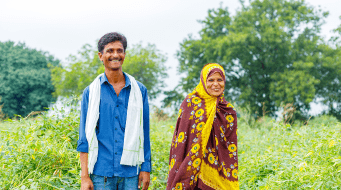
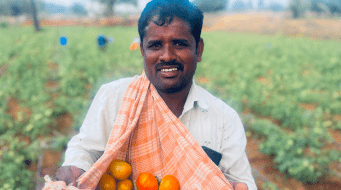
Godugu Krishna, a farmer in Telangana, transformed his 2.5-acre farm from debt-ridden to profitable through innovative water management and organic farming, supported by WOTR and HSBC. Initially reliant on rain-fed farming and struggling with high costs, Krishna adopted drip irrigation and diversified crops. This shift increased his yields and profits, allowing him to repay debts, expand into dairy production, and achieve financial stability. His success has turned skepticism into respect within his community.
When Kumpally Paapi Reddy and his wife K Venkata Laxmi started farming on rocky wasteland in Gaddamallaiahguda, Telangana, they were met with skepticism. Despite the challenges, they transformed the land through sheer determination and innovative practices. Partnering with WOTR and HSBC in 2020, they implemented water management strategies and shifted to organic farming.
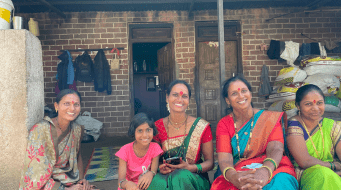
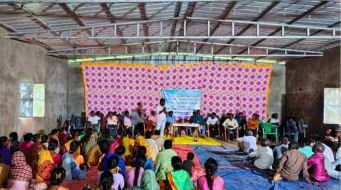
In a short span, these women from Gandharwadi village in Patoda, Beed, have forged deep bonds through Farmer Field Schools (FFS) initiated by WOTR and Axis Bank Foundation’s ‘Sustainable Livelihoods Programme’. Their journey from initial reluctance to newfound confidence showcases the transformative power of education and community support.
Years of low yields took a toll, but Kamli Bai refused to surrender. During the Rabi season, she worked tirelessly to establish a 0.1-hectare demo plot, her actions echoing the efforts of nine other farmers in Modwa village. Selected by the Village Development Committee and guided by WOTR, Kamli Bai diligently implemented every step, determined to prove these new methods could work. This year, a remarkable change swept through Kamli Bai’s fields.
With the arrival of the rabi (winter sowing) season, Adinath Manik Thombare, a farmer from Deulgaon Ghat in Beed gets busy sowing onions on his farm. He says he is relieved growing onions, given that only a few years ago, agriculture was largely unprofitable to pursue in his village due to unavailability of water. In need of solutions, Adinath started participating in training and exposure visits conducted by WOTR, under Axis Bank Foundation’s ‘Sustainable Livelihood Programme’.
Rajesh Mahto, 40, is always looking for money he can save or money he can make. Until 2019, Mahto used to ride an autorickshaw. Having all but quit agriculture, the 2019 lockdown imposed due to Covid-19 forced Mahto to give farming a second shot. He was aided in his efforts by WOTR which provided seeds, irrigation inputs, and advice on farming, through Axis Bank Foundation’s Sustainable Livelihoods Programme.
Narendra Adhikari, 58, is not afraid of experimentation. Agriculture fascinates him, and he says he is always looking to learn new approaches to growing food. His 1 acre vegetable garden – where Adhikari presently grows at least 25-30 varieties of herbs, fruits and vegetables – is a testament to this approach. Around 2019, he came in touch with WOTR, and started attending training sessions and going on exposure visits held by the organisation, under Axis Bank’s Sustainable Livelihoods Programme.
Paddy is the staple food for the majority of Narayanpet’s population and is grown in these parts extensively. Its cultivation has always been traditional, with farmers flooding the fields to grow it. Given the severe land and water constraints, WOTR decided to promote System of Rice Intensification (SRI) and System of Crop Intensification (SCI) amongst farmers under Axis Bank Foundation’s Sustainable Livelihoods Programme.
By Categories
By Tags
WOTR began mobilising farmers across Gajapati, Rayagada, and Ganjam in 2021, helping them form six Farmer Producer Companies (FPCs).
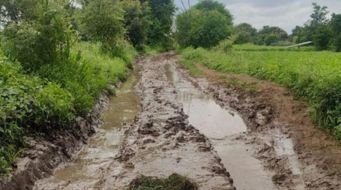
Exploring India’s farm roads, revealing how poor rural connectivity undermines productivity, mechanisation, incomes, and migration decisions nationwide.
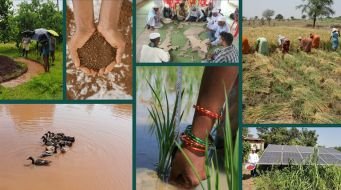
Reflecting on 2025, this blog captures how communities and WOTR strengthened water security, livelihoods, ecosystems, and climate resilience together.
Environmental awareness has never been higher, yet climate-damaging behaviour continues unchecked. This blog examines the growing green disconnect.
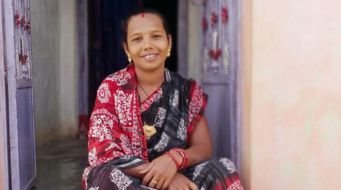
A woman farmer in Odisha rebuilds her livelihood through climate-resilient agriculture, soil health improvement, and collective market access support.
To understand how Monsoon 2025 affected farmers, we surveyed 545 farmers across Maharashtra and Madhya Pradesh in September.
View a curated selection of five WOTR films that we believe are a must watch for anyone interested in community-led development, water security, women’s empowerment, and long-term resilience.
The springs in Akole, Maharashtra, are more than just utility points for humans; they are the ecological heartbeat of the region