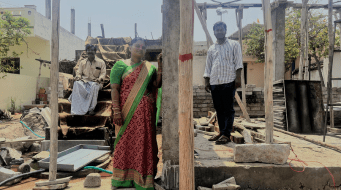
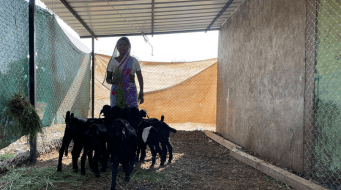
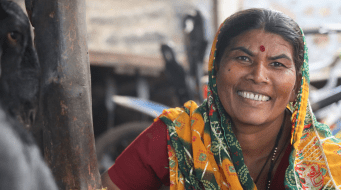
Sunita Jadhav from Bhandar Kumtha village, once struggling with daily wages, found new hope through goat rearing with support from Wells Fargo and WOTR. This venture provided her family financial stability, allowing her to earn a significant income and construct a shed for the goats’ safety.
A Better Tomorrow
Stories, Practices, and Solutions
In Kherda village, Vijaykumar and Sagarbai Kundgir exemplify resilience, transforming their small farm through vermicomposting to boost yields and earnings, while ensuring their children receive a quality education. Supported by Wells Fargo and WOTR, they increased their soybean yield and profits significantly.
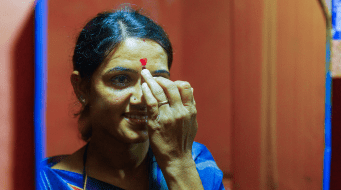
Sunanda Prakash Jante’s dream of becoming a beautician is finally taking shape with the support of a project that provided her essential tools to start her beauty parlour. Her story is one among many, empowering over 145 women in Aurad Taluka to establish various ventures through this initiative.
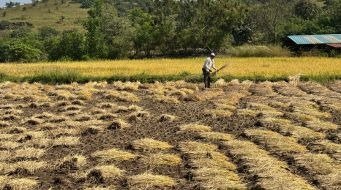
For Balaji Ajunshonde, farming is a way of life passed down through generations. After a devastating fire destroyed their harvest, assistance from Wells Fargo and WOTR brought renewed hope, boosting their income by 20% and transforming their resilience into a powerful story of recovery.
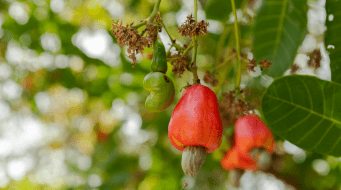
Odisha’s tribal communities face economic and livelihood challenges due to persistent water shortages and limited opportunities. This blog explores how cashew cultivation, supported by various government initiatives and NGOs, is transforming these communities. Historical struggles over land rights and recent developments in cashew farming are highlighted, showcasing both the challenges and the potential for sustainable agricultural practices.
Three years ago, Maheshwaram Panduranga and his wife Manga faced a severe water crisis on their 3-acre farm in Loyapally, Telangana. With help from WOTR and HSBC, they constructed a farm pond, significantly improving water levels. They then ventured into fish farming, earning substantial profits and transforming their financial situation. The couple now enjoys a better lifestyle and serves as an inspiration for others in their village.
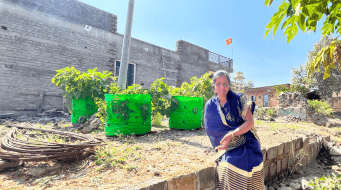
Aruna Ganesh Shivasagar, a resident of Kumbharwadi village, Sangamner, dreamt of growing her own food despite not owning land. With support from WOTR and Axis Bank Foundation’s ‘Sustainable Livelihoods Programme’, she embraced gurney gardening in her front yard. Despite initial skepticism, Aruna successfully cultivated a variety of vegetables, reaping a harvest within three months.
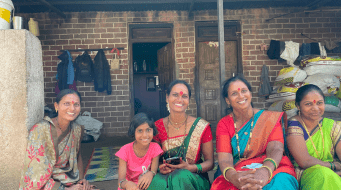
In a short span, these women from Gandharwadi village in Patoda, Beed, have forged deep bonds through Farmer Field Schools (FFS) initiated by WOTR and Axis Bank Foundation’s ‘Sustainable Livelihoods Programme’. Their journey from initial reluctance to newfound confidence showcases the transformative power of education and community support.
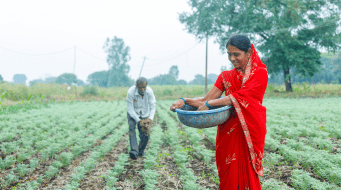
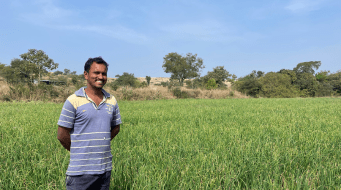
With the arrival of the rabi (winter sowing) season, Adinath Manik Thombare, a farmer from Deulgaon Ghat in Beed gets busy sowing onions on his farm. He says he is relieved growing onions, given that only a few years ago, agriculture was largely unprofitable to pursue in his village due to unavailability of water. In need of solutions, Adinath started participating in training and exposure visits conducted by WOTR, under Axis Bank Foundation’s ‘Sustainable Livelihood Programme’.
Babai Sahadev Selhar, aged 52, and her family, long-time traditional goat rearers in Beed, faced mounting challenges in recent years. Residing adjacent to a forest, their livelihood was threatened by persistent wild animal attacks, resulting in a significant loss of income, nearly a third of their total earnings. In response, Selhar was graciously provided with a goatshed by WOTR, facilitated through the Axis Bank Foundation’s ‘Sustainable Livelihood Programme in Maharashtra’.
By Categories
By Tags
When we mix weather,climate and climate change terms together, it can lead to confusion about what actually caused an event, who is responsible, and what actions are most effective
Explore WOTR’s 13-year journey across villages in Odisha, reaching over one lakh people through community-led watershed and livelihood interventions.
The Global South is being asked to shoulder the world’s nature and climate ambitions while global finance continues to move decisively in the opposite direction.
Read a collection blogs which brings together five stories from WOTR’s blog, shaped by the everyday lives, struggles, and choices of people in rural India. Told from the ground up, these pieces reflect moments of resilience, learning, and collective effort around water, livelihoods, and social change.
A water storage capacity of 2.5 million litres was created, bringing 64.25 acres of barren land back under cultivation while reducing soil erosion and improving groundwater recharge.
Maruti implemented a series of watershed interventions, including a farm pond and Water Absorption Trenches (WATs) to prevent surface runoff and recharge the aquifers
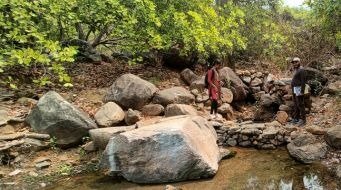
The Kadasi Revenue village in Odisha, which gets water from five springs, provided a closer look at the interplay between nature, community, and water resources to W-CReS researcher Navnath Ghodake during his field visit.
Farmers in rural Maharashtra are transforming their harvests and building climate resilience through innovative crop protection and sustainable agricultural growth.